
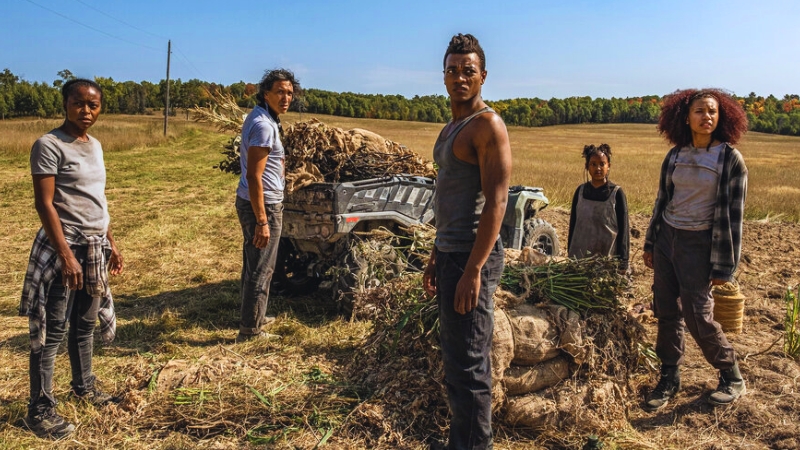
In R.T. Thorne’s riveting directorial debut 40 Acres, the apocalypse doesn’t arrive with aliens or asteroids — it comes in the form of ecological collapse, civil unrest, and the slow unraveling of humanity itself. Yet at the center of this survivalist tale is not just a fight for life, but a deep, personal struggle to preserve legacy, land, and the hard-won freedoms of generations past. Powered by a magnetic performance from Danielle Deadwyler, 40 Acres is a taut post-apocalyptic drama that explores racial identity, family bonds, and the question of whether survival at all costs is truly living.
A Matriarch on the Edge of a New World
Set in a not-too-distant future where the global food chain has imploded and war has ravaged most of civilization, 40 Acres introduces us to the Freeman family — a fiercely self-reliant Black and Indigenous clan living off-grid in rural Canada. Their land, inherited from ancestors who endured centuries of oppression, is both their sanctuary and their heritage. For Hailey Freeman (Deadwyler), the family’s steely matriarch, it is sacred ground that must be protected at any cost.
From the outset, we are thrust into a world that is harsh and unforgiving. A title card outlines the breakdown of society: a fungal pandemic has wiped out 90% of the animal kingdom, leading to the collapse of food systems, followed by famine and then civil war. The rural patch of land that the Freemans call home is now one of the few remaining places where food can grow and life can be sustained — a reality that turns farmland into power, and turns neighbors into threats.
Isolation as Philosophy and Strategy
The Freemans have survived because they’ve chosen to be alone. They maintain a strict perimeter policy, enforced by barbed wire and patrolled by their children, who are trained as both farmers and warriors. Hailey and her partner Galen (Michael Greyeyes, equally compelling in a quieter role) enforce this isolationist stance with near-militaristic discipline. Their four children — Emanuel (Kataem O’Connor), Raine (Leenah Robinson), Danis (Jaeda LeBlanc), and Cookie (Haile Amre) — grow up learning not just how to plant and harvest, but how to shoot, fight, and disappear.
But while this may sound dystopian, 40 Acres often feels intimate and grounded. Thorne — who co-wrote the screenplay with Glenn Taylor and Lora Campbell — is less interested in the collapse of global systems than he is in the collapse of personal ideologies. And for Emanuel, the eldest Freeman child, the family’s ethos is beginning to feel suffocating.
Emanuel’s Rebellion: The Cracks Begin to Show
It is Emanuel’s curiosity and quiet rebellion that kickstart the film’s central conflict. Restless and longing for something beyond the fences, he wanders through the woods and meets Dawn (Milcania Diaz-Rojas), a lone survivor who swims in a secluded pond near the family’s land. Despite his training — and his mother’s dire warnings — Emanuel is drawn to Dawn. She represents everything his world lacks: newness, risk, and connection. When he later finds her injured and desperate outside the farm’s perimeter, he hides her in the barn instead of reporting her. It’s a decision that will endanger not just himself but the entire family.
In many ways, 40 Acres mirrors the structure of classic Greek tragedy: a fateful act of compassion or defiance leads to an inexorable unraveling. Emanuel’s decision sets off a chain of events that pits the Freeman family against a brutal, cannibalistic militia that’s been preying on other survivors. These armed raiders, barely seen at first, represent the worst of post-collapse humanity — not just violence and conquest, but a hunger to erase what others have built.
The Legacy of Land: A Symbol of Reparations and Resistance
One of the most fascinating aspects of 40 Acres is the political and cultural symbolism of land itself. The family farm is more than a shelter; it is a living testament to the promise — and betrayal — of reparations. The film’s title is a clear reference to the historical “40 acres and a mule” order, issued in 1865 by Union General William Tecumseh Sherman as a short-lived plan to redistribute land to formerly enslaved Black Americans. That promise was quickly revoked, but its legacy — of land as empowerment — persists in Black consciousness.
Hailey understands this. For her, the land is not only a physical refuge, but a cultural one, steeped in ancestral struggle. She refuses to share it with anyone outside the family, not just because of the risks, but because she sees stewardship of the land as an act of resistance — a refusal to be uprooted again. Her skepticism of outsiders is as much historical as it is practical.
Deadwyler brings this ideology to life with ferocity and nuance. Known for roles that emphasize emotional resilience (Till, Station Eleven), she shines here in a different register — one that allows for both commanding authority and maternal vulnerability. Her Hailey is not just a warrior but a teacher, trying to instill her children with the strength to survive and the wisdom to remember where they came from.
Tension and Tenderness: Thorne’s Tonal Balance
Despite its dark premise, 40 Acres is not a grim slog. R.T. Thorne, whose background includes directing music videos and television, deftly balances tension with levity. The film is filled with moments of humor, play, and familial warmth. Whether it’s siblings teasing each other at the dinner table or joking around during combat drills, the Freemans feel like a real family — one that knows how to laugh even in the shadow of ruin.
This tonal dexterity is key to the film’s effectiveness. Too many post-apocalyptic stories lean heavily into despair. Thorne instead focuses on resilience, on how communities — even tiny, insular ones — can nurture love, creativity, and joy even when the world falls apart. That human touch makes the stakes feel real. When danger finally arrives, it hits hard, because we care deeply for these characters.
Thorne also uses music and cinematography to evoke mood rather than exposition. A particularly memorable scene shows Emanuel patrolling the farm’s edge while listening to k-os’ “Neutroniks,” a trippy, reflective track that underscores his inner turmoil. The song becomes a kind of anthem for Emanuel’s existential crisis — a young man caught between duty and desire.
Cultural Synthesis: Black and Indigenous Storytelling
Another standout element of 40 Acres is its blending of Black and Indigenous perspectives. Galen, as Hailey’s partner, brings Indigenous traditions and spiritual practices into the family’s teachings. The children learn not just survival skills but the rituals and philosophies of their dual heritage. Thorne doesn’t hammer this point; he allows it to flow naturally through the characters’ speech, actions, and values.
This synthesis reflects real-world intersections between Black and Indigenous communities in North America — groups that have often faced parallel struggles, including land dispossession, violence, and systemic erasure. By honoring both cultural lineages, 40 Acres becomes not just a story of survival, but one of reclamation.
Where the Film Falls Short: Incomplete World-Building
For all its strengths, 40 Acres doesn’t fully deliver when it comes to fleshing out its broader world. While the Freeman homestead is richly imagined — from its hand-built bunkers to its forested training grounds — the outside world remains frustratingly vague. We learn early on that a militia is targeting farms, and we see glimpses of their brutality, but their motivations, ideology, and social structure are never explored in depth.
Are they white nationalists? Mercenaries? Survivors turned predatory? The film leaves these questions open, and while ambiguity can sometimes be effective, here it feels like a missed opportunity. More context could have enriched the central conflict and raised the stakes for the Freemans’ decision to remain isolated.
Similarly, while the film alludes to a failed civil order and ecological collapse, it shies away from engaging with the geopolitics or environmental realities of its world. This is especially noticeable given the film’s obvious thematic debt to Octavia Butler, whose Parable of the Sower is directly referenced. Butler’s speculative fiction is beloved not just for its emotional insight, but for its meticulous, research-based world-building — a standard 40 Acres doesn’t fully reach.
A Compelling Debut Rooted in Love, Legacy, and Resistance
Despite its minor shortcomings, 40 Acres is an exceptional debut from R.T. Thorne — a filmmaker with both vision and voice. It’s a film that understands the power of land, family, and identity in a world that wants to strip all three away. Anchored by Danielle Deadwyler’s commanding performance and a beautifully cast ensemble, the story blends post-apocalyptic tension with rich cultural storytelling and deeply human stakes.
More than just a survival thriller, 40 Acres is a meditation on what it means to protect not only your loved ones but your history — and to carry forward the fight for dignity and belonging in a world that has seemingly forgotten both.
This is one of the most urgent, original post-collapse films in recent years — one that plants its roots deep and dares to grow something luminous in the dark.