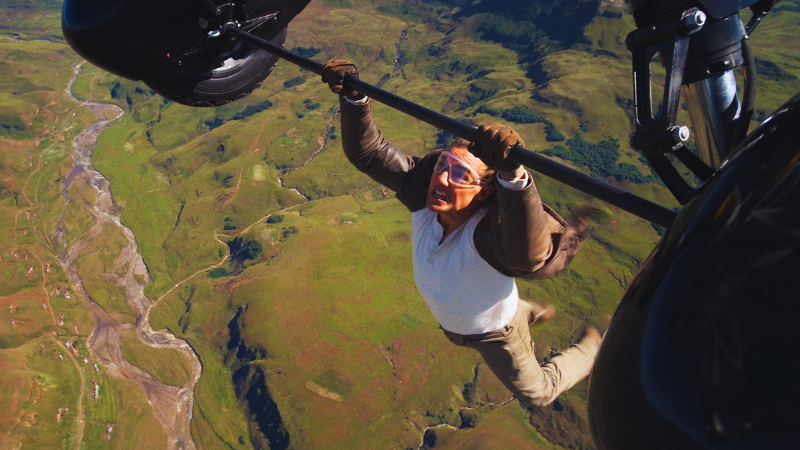
For nearly three decades, Tom Cruise has defied the conventions of Hollywood action stars. With every new installment of the Mission: Impossible series, he doesn’t just raise the bar—he leaps over it, often quite literally. In Mission: Impossible – The Final Reckoning, Cruise delivers what may be his most extreme, death-defying performance yet, performing stunts that test the limits of human endurance and redefine the boundaries of practical filmmaking.
This film marks a dramatic culmination of the Mission: Impossible franchise—a cinematic saga known for high-concept espionage, international intrigue, and action sequences grounded in authentic, real-world peril. From gripping biplane stunts to record-setting parachute dives and claustrophobic underwater scenes, this installment is not just a farewell to Ethan Hunt—it’s a love letter to physical storytelling, discipline, and the pursuit of realism in cinema.
The Biplane Stunt That Pushed Everyone to the Edge
One of the most jaw-dropping moments in The Final Reckoning features Cruise clinging to the wing of a vintage biplane as it soars through the sky at more than 140 miles per hour. No green screens. No stunt doubles. Just Tom Cruise, thousands of feet in the air, gripping the edge of a flying machine.
To prepare for this sequence, Cruise trained extensively with aerobatic pilots and flight safety specialists. He studied the mechanics of the Boeing Stearman biplane and completed multiple practice runs where he climbed from the cockpit to the wing mid-flight. Each repetition refined his movement and timing until it became second nature. But even with training, the danger was immense. Wind force at that altitude is punishing, and one misstep could be catastrophic.
The crew built special camera rigs onto the aircraft to capture Cruise’s performance from every possible angle, including overhead drones and custom nose-mounted lenses. No visual effects were used to fake the stunt—every moment was real, down to the shaking of Cruise’s limbs and the way the plane banked sharply as he moved.
Real Fear and Real Consequences
The physical toll of the biplane stunt was enormous. During one take, Cruise reportedly struggled to return to the cockpit as the plane approached the edge of its fuel limits. The team on the ground watched nervously as he maneuvered back into the aircraft with seconds to spare. The pressure wasn’t just cinematic—it was life and death.
This sequence became emblematic of the film’s entire approach. Director Christopher McQuarrie, who has collaborated with Cruise on several Mission: Impossible films, emphasized that every frame needed to feel real. The stakes had to be visible in Cruise’s eyes, in his sweat, in the sound of his breath. And that realism could only come from putting the actor in the actual danger his character faced.
Setting a Record with a Burning Parachute Jump
As if wing-walking on a moving plane weren’t enough, The Final Reckoning also features a flaming parachute sequence that broke a world record for the most consecutive fire-based parachute jumps performed by an actor.
The setup: Cruise jumps from a plane at over 7,500 feet, ignites a flammable gel sewn into a specially designed suit, and falls through the sky while on fire before deploying a secondary chute. The flames lasted only a few seconds, but during that time, Cruise had to maintain control of his descent, monitor the burn, and ensure he could activate his emergency equipment if anything went wrong.
This wasn’t done just once. Cruise repeated the jump sixteen times across several days to get all the angles needed for the scene. Each dive required complete recalibration of the camera positions, timing of the fire ignition, and parachute deployment.
Only a few stunt professionals in the world have ever attempted anything similar, and none have done it while acting in character, speaking lines, and delivering emotional weight mid-descent. The combination of performance and risk is something only Cruise has mastered at this scale.
Deep Dive: Submarine Sequences and Underwater Realism
Another highlight of the film involves a breathtaking sequence set inside a sunken Russian submarine. While many films would rely on CGI or underwater sound stages, Cruise insisted on filming these scenes practically.
A massive water tank was constructed to simulate the interior of the submarine, complete with tight hallways, rising water levels, and flickering emergency lights. Cruise wore a full-body diving suit with a weighted rig, adding over 50 pounds of resistance. He trained for months with freediving experts to build up his lung capacity, eventually holding his breath for over six minutes at a time.
The complexity of filming underwater added multiple layers of challenge. Actors had to perform coordinated movements in confined spaces while managing buoyancy, oxygen, and the demands of the scene. Cruise led by example, diving repeatedly without hesitation. His comfort in the water helped the cast and crew push beyond their limits.
The result is a series of scenes that feel claustrophobic, intense, and terrifyingly authentic. You feel the weight of the water, the pressure of time, and the primal urge to escape—a reflection of the character’s emotional state as well as the physical stakes of the mission.
How the Stunt Team Made the Impossible Possible
Behind every Tom Cruise stunt is a battalion of experts, from stunt coordinators and rigging technicians to safety officers and emergency responders. Leading that team is Wade Eastwood, Cruise’s longtime stunt collaborator. Eastwood and his crew spent years planning, testing, and refining the set pieces in The Final Reckoning.
The biplane stunt required flight approvals from international aviation authorities, custom-engineered harnesses, and an emergency ground team tracking Cruise’s vitals in real time. The parachute scene involved multiple safety nets, including pyrotechnic specialists who precisely timed the fire to ignite and extinguish without harming Cruise.
Even the submarine tank was rigged with hydraulic lifts, air bubbles, and light filters to simulate underwater visibility and pressure changes. Safety was paramount, but so was authenticity. Every department was aligned with one goal: bring Ethan Hunt’s world to life without cheating the camera.
Emotional Weight: Why These Stunts Matter
What separates Mission: Impossible from other action franchises isn’t just spectacle—it’s emotional resonance. The stunts serve the story, not the other way around.
When Ethan Hunt jumps from a burning plane or wrestles with the hatch of a sunken vessel, it’s not just to wow the audience. These moments are visual metaphors for the character’s journey. Hunt is a man constantly pushing himself to the edge, driven by guilt, loyalty, and the burden of his choices. The stunts aren’t just thrilling—they’re character-defining.
Cruise understands this on a profound level. He isn’t doing these things for headlines. He’s doing them because he believes that audiences can feel the difference between digital illusion and physical effort. The pain, the strain, the uncertainty—they all translate on screen, making the experience more visceral and more rewarding.
Legacy of a Franchise: Saying Goodbye with Impact
The Final Reckoning is expected to be the final chapter for Ethan Hunt, though Cruise has teased that the door is never completely closed. If this truly is the end, it’s a fitting farewell. The film is packed with callbacks to earlier installments, emotional reunions, and philosophical questions about duty, identity, and sacrifice.
It also reaffirms what the franchise has always stood for: pushing the limits of what’s possible on screen. Cruise has spent years proving that you don’t need to fake greatness—you can achieve it with sweat, discipline, and sheer will.
A New Benchmark in Action Cinema
As the industry leans increasingly toward digital effects and green-screen environments, The Final Reckoning stands as a monument to practical filmmaking. It reminds us that the most powerful images are often the ones rooted in reality. Watching Cruise dangle from a plane or plunge into the depths of a flooded submarine feels different because it is different. There’s no substitute for authenticity.
More importantly, the film raises the question of legacy. Cruise, at 62, continues to defy age and expectation, proving that action is not about muscle alone—it’s about courage, clarity, and commitment to the audience.
A Reckoning Worth Waiting For
Mission: Impossible – The Final Reckoning is more than just an action movie. It’s a cinematic statement, a culmination of years of ambition, and a tribute to the magic of practical filmmaking. Tom Cruise’s commitment to performing the most dangerous stunts of his career elevates the film from entertainment to event.
Whether it’s flying through the sky on a biplane, jumping from a flaming parachute, or navigating the depths of a submerged death trap, Cruise does it all with the same passion he’s shown since the franchise began. And in doing so, he reminds us that the impossible isn’t something to avoid—it’s something to chase.
This film isn’t just the end of an era. It’s the crowning moment of one of the most ambitious, daring, and emotionally satisfying franchises in modern film history.