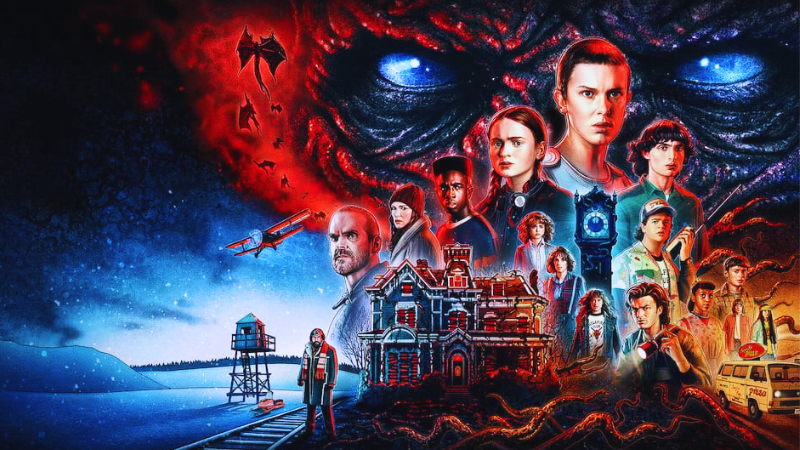
As Stranger Things enters its highly anticipated fifth and final season, the Duffer Brothers and their production team are going all-in to deliver a conclusion that surpasses anything fans have seen before. With nearly a year of filming and an equally intensive post-production schedule, Season 5 is being treated more like a theatrical blockbuster than a traditional streaming series. Each episode is crafted with the scale and ambition of a feature film, thanks largely to the groundbreaking work of its visual effects (VFX) teams. In this article, we’ll dive into how the visual effects of Season 5 are not only breaking technical ground but also redefining what’s possible for a streaming series.
Turning Television into Cinema
One of the most striking things about Season 5 is how it’s being conceptualized: not as a TV show, but as eight interconnected movies. According to creators Matt and Ross Duffer, each episode is built with the intention of delivering the narrative scale and visual punch of a blockbuster film. This vision significantly raises the bar for VFX teams, requiring them to think beyond television standards and operate within the realm of high-budget cinema.
The decision to go this route is partly driven by the series’ cultural importance. Since its debut, Stranger Things has not only become one of Netflix’s most watched shows but also a benchmark for how genre television can rival Hollywood in terms of quality and spectacle. Season 5 is meant to be the culmination of that journey—a showcase of everything the show has done well, only on a much larger scale.
Extended Production for Complex VFX
Season 5 was filmed over nearly 48 weeks, one of the longest production schedules for a streaming series in recent memory. While that may seem excessive for eight episodes, it becomes entirely reasonable when you consider the scope of what’s being attempted. The visual effects pipeline needed this time to craft detailed environments, animate complex creatures, and seamlessly integrate digital elements with practical footage.
This extended production schedule allows for something rarely afforded in episodic content: refinement. Rather than rushing to meet tight weekly deadlines, VFX artists are given the time to polish every frame, ensuring that the final product feels as immersive and cohesive as a major studio film.
Crafting the Upside Down
A cornerstone of the Stranger Things aesthetic has always been the Upside Down, a haunting mirror world filled with decay, darkness, and supernatural horror. In previous seasons, the Upside Down was largely limited to certain environments and setpieces. But in Season 5, it plays a much more expansive role.
The Duffer Brothers have teased that the Upside Down will bleed more aggressively into Hawkins, creating a fusion of realities that demands enormous digital world-building. This isn’t just about adding vines to buildings or changing the color palette; it involves building entirely new environments from scratch, complete with dynamic lighting, particle effects, and atmospheric distortions.
VFX teams are using a combination of practical on-set elements and CGI overlays to bring the Upside Down to life. Buildings are shot on location and then digitally transformed to appear decayed and corrupted. Roads crack open with supernatural energy. Trees shimmer with otherworldly spores. This kind of environmental storytelling requires more than just technical skill—it demands creativity and narrative intuition.
Monsters That Terrify and Move
Season 5 promises to deliver even more frightening creatures than any previous season. While Season 4 introduced Vecna—a central antagonist whose appearance was achieved mostly through practical effects—Season 5 is upping the ante with a mix of practical and digital design.
These new creatures aren’t just background horrors. They’re deeply integrated into the story, requiring performance capture, facial rigging, and realistic animation. VFX teams have developed entirely new pipelines for creature simulation, using software that allows skin, muscle, and even moisture to behave in a lifelike manner.
Moreover, these monsters need to interact with the environment and with the actors. That means precise motion tracking, collision detection, and lighting adjustments to ensure that every shadow, reflection, and physical interaction feels authentic. When a character touches a creature, audiences must believe that creature exists in that moment—not as a digital creation, but as a physical threat.
The Return of Vecna and Advanced Prosthetics
Vecna’s return is perhaps one of the most anticipated elements of Season 5. Though heavily practical in Season 4, the character is now being enhanced through digital means to reflect his evolution. The result is a blend of prosthetic mastery and digital augmentation.
The makeup team builds the foundation with latex, paint, and mechanical rigs. Then, VFX artists step in to animate subtle enhancements—like pulsating veins, shifting shadows, and facial expressions that would be difficult to achieve mechanically. The result is a hybrid villain who remains grounded in practical realism but is elevated through digital wizardry.
Inverted Environments and Reality Distortion
A standout feature of Season 5’s visual style is the use of reality distortion. As Hawkins and the Upside Down begin to merge, viewers will experience shifting environments, gravity-defying effects, and altered physics. This isn’t just eye candy; it’s a thematic representation of chaos encroaching on order.
To achieve this, VFX artists are using real-time rendering techniques that allow environments to morph dynamically based on characters’ actions. Streets curl into the sky. Staircases collapse into themselves. Mirrors show alternate timelines. These effects are coded to react organically, simulating a world that is alive and unpredictable.
New Tools and Real-Time Visualization
The advancement in technology since Season 1 is immense. For Season 5, production teams have employed cutting-edge tools like Unreal Engine for real-time visualization. Directors can now see a rough version of the final VFX shot on set, allowing for better planning, framing, and lighting.
This real-time feedback loop also helps actors, who can better react to what will ultimately be on screen. Rather than acting against a green wall with little context, they can see approximations of what the Upside Down will look like, where creatures will emerge, and how the environment will respond.
Sound and Visuals Working in Tandem
Sound design is a crucial part of Stranger Things, and in Season 5, it’s more tightly integrated with VFX than ever before. Every ripple in the Upside Down, every growl from a creature, every spatial anomaly is paired with sound that enhances the emotional weight of the moment.
Rather than adding sound after the fact, the VFX and audio teams work in parallel. When a character is pulled through a rift, the visual cue of the distortion is accompanied by layered sound—cracks, moans, electrical surges—that intensify the experience. This seamless integration deepens immersion and heightens tension.
Practical Sets Enhanced with CGI
While digital effects are key, the production team remains committed to using practical sets wherever possible. Buildings, streets, and interiors are constructed with meticulous detail, then enhanced through CGI. This hybrid approach maintains a sense of physical reality while allowing for supernatural augmentation.
For instance, a hospital room might be built entirely with practical elements, but as a scene progresses, vines creep through the walls, lights flicker with unnatural colors, and shadows elongate in impossible directions. All of this is added in post, but it starts with a foundation grounded in physical space.
The Ticking Clock of Post-Production
Perhaps the most challenging aspect of producing such elaborate VFX work is managing time. With Netflix’s commitment to global simultaneous release, the post-production team is working under tight deadlines. That means thousands of individual shots must be rendered, composited, color-graded, and reviewed within a narrow window.
Each visual effects shot undergoes multiple iterations. Initial versions focus on structure and animation, followed by lighting passes, texture mapping, and final compositing. These shots then go through rounds of approvals, often requiring quick adjustments based on narrative pacing or performance tweaks.
Redefining What Streaming Can Be
Season 5 of Stranger Things doesn’t just conclude a beloved story; it signals a shift in how streaming series are produced and perceived. With its film-quality effects, massive scale, and extended production timeline, it proves that streaming can rival or even exceed theatrical releases in visual ambition.
Netflix, once known for binge-ready programming, is now pioneering what could be the future of episodic storytelling: serialized cinema, delivered at home, but crafted with the care and precision of a summer blockbuster.
The Final Frontier of Visual Imagination
As the final season nears release, it becomes increasingly clear that Stranger Things has always been about pushing boundaries—narrative, emotional, and visual. Season 5 represents the culmination of that ethos. With its groundbreaking visual effects, the series is not only closing out its narrative with spectacle but also establishing a new gold standard for what is technically and artistically possible on a streaming platform.
From morphing realities to terrifying new creatures, from practical innovation to digital artistry, Stranger Things Season 5 is shaping up to be not just the end of a beloved series, but the beginning of a new era for streaming television.