
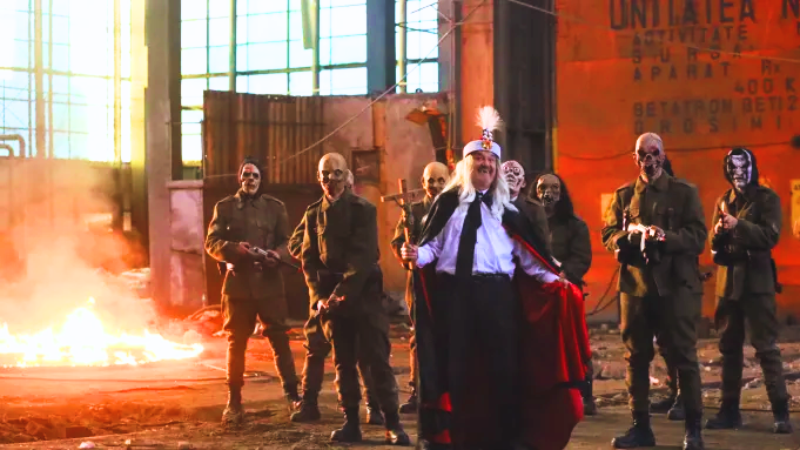
In a striking development this week, New York–based independent distributor 1‑2 Special has acquired North American rights to Dracula, the much-anticipated new film by acclaimed Romanian auteur Radu Jude. Heralded for his audacious cinematic voice, Jude brings his signature blend of irony, historical resonance, and formal inventiveness to a genre-bending reinterpretation of Bram Stoker’s gothic classic. That Dracula will play under 1‑2 Special’s banner signals both Jude’s growing international status and the rising appetite among indie distributors for bold, auteur-driven fare.
Radu Jude: From Romanian New Wave to International Auteur
Radu Jude’s name has long been synonymous with watchful, morally complex cinema. A graduate of the Media University of Bucharest, Jude rose through the art-world circuits with short films like The Happiest Girl in the World and Alexandra, which screened across Sundance, Rotterdam, and Oberhausen. Known for dissecting collective memory and confronting uncomfortable national histories—whether through found-footage essays or confrontational drawing-room dialogues—Jude has since made his mark in features such as Aferim! and Bad Luck Banging or Loony Porn, the latter earning critical acclaim at the Berlin Film Festival.
With Dracula, Jude pushes beyond his Eastern European roots to tackle global mythology. Shifting from domestic allegory to mythic exploration, he reframes a universally known horror icon through a lens that is simultaneously classical, absurdist, and pointedly self-referential. He has described it as “a love letter to Ed Wood,” and with its comedic undertones, it seeks to reanimate Dracula—historian Neal Cohn once described as a symbol of imperial anxiety—with a postmodern twist.
What Makes Dracula Distinctive
Scheduled to premiere at the 78th Locarno Film Festival this August, Dracula emerges from a multi-national production spanning Romania, Austria, and Luxembourg. With a 170-minute runtime, the film is clearly designed to be both sweeping in scope and demanding in attention.
Jude’s Dracula is not merely a horror reconstruction. It deliberately detours into comedy and historical rumination. By blending Romanian-language authenticity with scenes in German and English, he turns the figure of Dracula into a polyglot palimpsest. His casting choices reinforce this: Adonis Tanța plays the eponymous Dracula, supported by performances from Oana Mardare, Șerban Pavlu, and Serban Pavlu, among others. Cinematographer Marius Panduru, a longtime collaborator, again frames Jude’s formal playfulness with darkly luminous visuals and dense staging, while editors like Cătălin Cristuțiu shape sprawling scenes with calculated pacing.
Early reviews praise the film’s ability to transition between horror and absurdity. Some critics point to elements reminiscent of Ed Wood’s off-kilter charm, while others note that Jude’s Dracula resists easy categorization—it is neither parody, Hitchcock homage, nor drama. Jude’s stylistic fluency is on full display.
A Bold Acquisition by an Emerging Distributor
1‑2 Special isn’t a household name. Founded only a few years ago, the indie outfit has quickly developed a reputation for picking up high-yield art-house titles. Their acquisition of Dracula continues this trend. The timing—on the eve of a major festival premiere—demonstrates strategic ambition. By securing North American rights early, before Locarno buzz peaks, the distributor positions itself to benefit from critical hype.
The Screen Daily headline aptly captured the moment: “Ambitious fledgling New York distributor 1‑2 Special has swooped on North American rights to Radu Jude’s Dracula”. Deadline echoed the sentiment: “1‑2 Special Takes North America For Radu Jude’s ‘Dracula’ Ahead Of Locarno Debut”. This is not only a bet on Jude’s longstanding name recognition in film circles, but also a reflection of niche audiences’ growing appetite for rigorous European cinema.
Locarno as Launchpad
Locarno has been a notable advocate for international auteurs, offering prestige and visibility. For Jude, whose previous films won the Golden Leopard and drew major festival attention, Locarno functions as a central platform. Among the festival’s Main Competition lineup, Dracula is likely to attract both trade and cinephile audiences. With North American distribution already secured, the film bypasses a crucial barrier often faced by foreign-language cinema: how to translate festival interest into theatrical calendars.
Depending on response, Dracula could find its way into select theatrical runs in major urban centers, followed by rollouts to art-house chains. Early buzz around Locarno could help build a platform release model. A carefully timed North American rollout—ideally in early 2026—could anchor award-qualifying runs and activate streaming or broadcast partnership windows.
Genre Reinvention and Cultural Commentary
What makes Jude’s take on Dracula compelling is not only its scope but its social critique. In previous films, he has dissected authoritarian legacies, collective guilt, and rural-urban disconnect in Romania. Dracula repurposes the vampire myth as a complex metaphor for post-imperial reckoning. Gothic mythologies often mask anxieties about identity, borders, purity—even today’s refugee crises.
Early reports from Locarno suggest that the film’s humor undercuts its gothic aesthetic, casting Dracula not as an omnipotent monster but as a sometimes befuddled—and possibly bureaucratically hampered—figure. The fact that the screenplay toggles languages and cultural reference points only emphasizes Jude’s intention to locate Dracula not in superstition but in human systems: immigration, translation, class structures. In his hands, Dracula is a parasite not just by mythos but through socio-economic allegory.
Building Reputation: Jude’s International Trajectory
Dracula arrives at a pivotal moment in Jude’s career. With Bad Luck Banging earning an Academy Award nomination for best international feature, and Imaculat generating arthouse applause, Jude had already established himself as both globally relevant and fiercely rooted in Romanian sensibilities.
This film extends his reach into genre territory. Just as Yorgos Lanthimos moved from provocative realism to science fiction with Poor Things, Jude’s genre pivot could broaden his audience without sacrificing critical credibility. Indeed, as Dune Part 2 and other genre-scale narratives ride high, European auteurs like Jude have opportunity to redefine category constraints while retaining auteur trademarks.
Strategy Behind 1‑2 Special Acquisition
The partnership between Jude and 1‑2 Special appears strategic. The distributor is building a brand identity tied to emerging auteurs. If Dracula delivers localized commercial success—say, $500K in urban box office—it proves the viability of art-house genre hybrids. That, in turn, solidifies the distributor’s bargaining position for future high-profile picks across European cinema.
Moreover, Jude’s Dracula, with its multilingual format, would fit well into major festivals like Toronto or New York, where North American distributors and critics can amplify its reception. With early OK secured, promotional plans can proceed alongside festival marketing cycles.
What Lies Ahead for Dracula
Once Locarno premieres the film in August, attention will turn to how it’s received by festival juries and critics. Under European distribution, the film has already secured a release date for July 2025. Now, in North America, building a campaign that balances highbrow critique with genre appeal will be pivotal.
Ideally, the film would roll out to AMC and Alamo Drafthouse houses by late 2025, followed by a streaming release timed to award season. Given Jude’s emerging US profile, best international feature buzz could help sustain a long tail of attention in niche circuits.
The Larger Picture: Global Art-House Convergence
The acquisition of Dracula by 1‑2 Special is symptomatic of shifting patterns in cinema distribution. Platforms and distributors are increasingly willing to take calculated risks on auteur cinema that straddles genre. This aligns with wider trends—Netflix’s backing of Yorgos Lanthimos, A24’s embrace of Robert Eggers, and IFC’s success with Radu Jude’s past films.
For audiences, this translates to new opportunities. Watching Dracula isn’t just about engaging with a vampire movie; it means interacting with a transnational, multilingual cultural experience deeply aware of its history and absurdity.
A Promising Future for Dracula in North America
Radu Jude’s Dracula, now secured for North American release by 1‑2 Special, is more than a festival footnote—it’s a statement. It declares European auteurs can reimagine established genre forms while remaining fearless in political and historical insight. It illustrates the growing ability of small distributors to champion such films on home turf.
As the world prepares to meet Jude’s Dracula this August, the artistry on display promises more than gothic thrills. It reveals a filmmaker reworking myth into mirror, reflecting our anxieties about identity, nationhood, language—even absurdity.
When it arrives, Dracula will not just be an event in Locarno; it will make its way into the urban theaters, cinephile hearts, and cultural discourse of North America. All for the better: because cinema thrives when its storytellers refuse to settle for safe. Radu Jude and 1‑2 Special just made horror a little smarter—and the marketplace a little wider.