
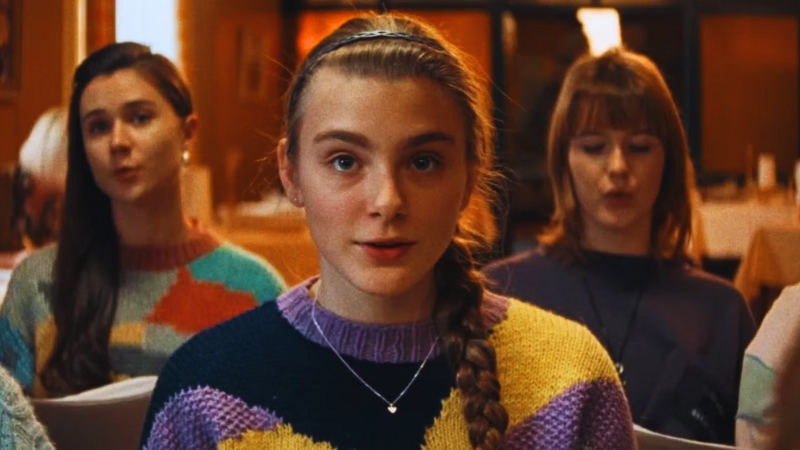
In Broken Voices (Sbormistr), Czech writer-director Ondřej Provazník delivers a haunting, nuanced depiction of adolescence shattered by betrayal. Based on harrowing real events, the film revisits the abuse scandal involving the Bambini di Praga (Children of Prague), a world-renowned Czech children’s choir whose conductor was convicted in 2008 of sexually abusing dozens of teenage girls. Provazník does not sensationalize the subject matter; instead, he crafts a quiet, emotionally intelligent drama that illuminates the internal and external pressures faced by young girls coming of age in a rapidly changing post-communist society.
Premiering at the Karlovy Vary International Film Festival, Broken Voices has already begun attracting critical praise for its restrained direction and powerful performances. Though the narrative might seem familiar — an authority figure exploiting his position within an institution that offers opportunity and prestige — the film gains its potency through meticulous attention to emotional detail and a deep understanding of cultural context.
A Nation in Transition, A Choir in the Spotlight
The story is set in the early 1990s, a pivotal moment for the Czech Republic. Just a few years after the Velvet Revolution, the country was emerging from decades of communist rule, opening its doors to the West and redefining itself on the global stage. For young people, especially girls from working-class families, the future held thrilling possibilities — but also new forms of vulnerability.
This is the world inhabited by sisters Karolína (played with aching vulnerability by Katerina Falbrová) and Lucie (a compelling Maya Kintera), who dream of joining a prestigious youth choir led by the charismatic but deeply troubling conductor, Vít Macha (Juraj Loj). The choir, revered for its international acclaim, becomes a gateway to a different life: one filled with travel, acclaim, and escape from the constraints of home. For the sisters and others like them, being selected is not just about musical talent — it is a ticket to a better future.
But within this elite world lies a predator. Vít Macha, a man who presents himself as a musical genius with a gift for elevating young voices, is anything but benevolent. From the very beginning, Provazník paints him with a subtle but chilling brush — flamboyant, egoistic, and disturbingly comfortable among his adolescent protégées. The cues are all there, yet as with so many real-life cases, the adults and systems around him look the other way.
The Personal and the Political
Provazník smartly ties the personal tragedies unfolding in Broken Voices to the broader sociopolitical environment of the time. The early ’90s were filled with optimism but also chaos; institutions were fragile, and old rules had vanished without new ones fully taking hold. In this atmosphere of transition, predators like Macha thrived.
The parents in the film — especially Karolína and Lucie’s — are depicted not as negligent, but as desperate. They see their daughters’ talent as a rare opportunity and pour their hopes into the choir. In doing so, they inadvertently ignore the subtle signs of distress, failing to grasp that the very institution they trusted is quietly destroying their children.
This dynamic adds layers of emotional tension. Karolína, initially in her sister’s shadow, gradually emerges as the new “favorite” of Macha — a shift that sows jealousy among the other girls and creates a rift between the siblings. Lucie, once the star, begins to retreat after a disturbing off-screen encounter with Macha. Her silence is deafening, and her withdrawal from the spotlight marks the beginning of a grim pattern. As Lucie fades, Karolína is thrust forward — vulnerable, unready, and now in Macha’s crosshairs.
A Chilling Slow Burn
Rather than focusing on graphic depictions of abuse, Broken Voices opts for emotional realism and psychological weight. The horror lies not in what is shown, but in what is implied — a technique that makes the viewer a complicit witness, forced to read between the lines just as the characters must.
When Macha isolates the choir for a two-week boot camp at a remote ski resort, the setting itself becomes an accomplice. There, he mixes professional rigor with disturbing intimacy — pushing the girls to physical and emotional extremes during rehearsals, then luring them into saunas and social events that blur the boundaries between teacher and student. Karolína, who initially basks in her newfound attention, slowly begins to feel the tightening noose of control and coercion.
By the time the choir travels to New York for their U.S. tour, the film’s emotional tone becomes even more suffocating. In a stunningly staged sequence, Macha finally corners Karolína in a posh Manhattan hotel room. The entire scene unfolds in a single, fixed shot — a creative decision that underscores both Karolína’s helplessness and the voyeuristic silence that so often surrounds abuse. Through the window, a neighboring apartment glows with normalcy — a jarring contrast to the psychological violence playing out next door.
The Choir as Metaphor
Music plays a dual role in Broken Voices. On the surface, it is a path to personal and professional advancement. The girls’ harmonies are angelic, their performances mesmerizing. But beneath the beauty lies contradiction. The same voices that earn them applause are also the ones that silence their pleas. The choir, intended as a space of uplift and empowerment, becomes a place of entrapment and submission.
Provazník uses music not just as a narrative device, but as a metaphor. The idea of “perfect pitch” — repeatedly emphasized by Macha — becomes symbolic of the way girls are forced to conform, to present a polished surface even while suffering underneath. In striving to achieve sonic perfection, they sacrifice their emotional truths.
Yet music is also where the film finds its most powerful moments of resistance. In one particularly moving scene, Karolína steps forward during a rehearsal and sings solo — her voice trembling but defiant. It’s not just a performance; it’s an act of reclaiming her agency. Even in a world where so much is taken from her, she can still choose to be heard.
Aesthetic Choices and Performances
Shot on grainy 16mm film, Broken Voices achieves a lived-in, period-specific aesthetic that immerses viewers in the early ’90s atmosphere. The cinematography feels intimate and observational, favoring natural lighting and handheld movement to emphasize the raw emotional state of its characters. This stylistic decision heightens the film’s documentary-like realism while also invoking a sense of nostalgia — both for a more innocent time and for a country still finding its footing.
The performances are uniformly strong. Katerina Falbrová is exceptional as Karolína, capturing a range of emotions from quiet awe to internalized fear. Her transformation from eager newcomer to wary survivor is rendered with heartbreaking subtlety. Maya Kintera, as Lucie, delivers a powerful, understated portrayal of trauma and withdrawal. And Juraj Loj is chillingly convincing as Macha, balancing outward charm with an undercurrent of menace that never slips into caricature.
A Necessary Story, Told with Care
What sets Broken Voices apart from other films tackling similar themes is its careful attention to nuance. There are no easy villains or tidy resolutions. The abuse happens in the shadows, disguised as mentorship. The victims often don’t have the language to describe what is happening to them, and the adults around them are too invested in the system to confront it. This, sadly, mirrors the reality of many abuse cases — not just in the Czech Republic, but globally.
Yet the film doesn’t wallow in despair. It offers glimmers of hope, primarily through Karolína’s resilience and the enduring power of music. The final scenes suggest that while institutions may fail, individuals can still find ways to speak their truth — even if their voices shake.
Conclusion
Broken Voices is a sobering, beautifully realized drama that explores how systems of power can exploit innocence under the guise of opportunity. By situating the story within a specific cultural and historical context, Provazník gives the film an added layer of complexity. But it’s the emotional honesty — and the unflinching portrayal of how young girls are shaped, wounded, and ultimately strengthened by their experiences — that leaves the most lasting impression.
This is a film that doesn’t just demand to be seen; it demands to be heard.