Since debuting as Wednesday Addams in Netflix’s breakout hit, Jenna Ortega has become one of the most talked-about young actors of her generation. In the span of a few years, she has emerged as a style icon, an advocate for social causes, and a boundary-pushing performer. As production gears up for Wednesday Season 2, Ortega sat down for an exclusive conversation about the series’ evolution, the weight of Gen Z fame, and the influence of her horror inspirations. What follows is an in-depth look at a rising star whose ambition is as layered as her characters.
Stepping Back Into Nevermore Academy
In Wednesday Season 1, Ortega introduced audiences to a suspiciously stoic teenager navigating supernatural mysteries at Nevermore Academy. The end of that first season left many story threads unresolved—intergenerational trauma, a burgeoning telepathic power, and a newfound romantic entanglement. Ortega shared how she approached Season 2 by returning to Nevermore with fresh intent. She told me that the scripts delve deeper into Wednesday’s psychology, exploring new facets of her relationship with Enid, Thing, and her estranged family. More than just shining a light on witchcraft and mystery, Season 2 explores identity, agency, and resolution.
Ortega emphasized the tonal growth of the season. Where Season 1 balanced gothic wit with coming-of-age drama, Season 2 embraces earned humor, emotional depth, and the stakes of leadership. “I’ve grown with Wednesday,” she said, voice softening. “This season she’s braver, not because she’s changed who she is, but because she’s choosing to trust others.” A key thread she’s most excited for fans to watch is Wednesday’s mother-daughter journey with Morticia Addams, played by Catherine Zeta‑Jones. Their tumultuous reconciliation anchors the season’s heart.
The Alchemy of Casting and Iconic Performance
Jenna Ortega’s Wednesday is more than a cynical vibe board brought to life—her performance is kinetic intelligence laced with tremors of hidden pain. She shared that the early days of shooting Season 1 were about rooting Wednesday in contrast: stoic on the outside, emotionally attuned inside. Playing a nontraditional teenager meant listening more than speaking, and ensuring each side‑eye or pause carried intention. Season 2 gave her more lines of dialogue than in all of Season 1 combined, a shift she welcomed as a chance to balance her intensity.
She spoke with admiration for her director Tim Burton, whose hallmark style of exaggerated sets and musical crescendos shaped Wednesday’s world. Jenna revealed that Burton encouraged her to lean into her body language. He once asked her to stand motionless for an entire monologue, trusting her physical presence to speak volumes. For Season 2, she said, Tim aims to channel a gothic coming‑of‑age tone—not a horror slapstick. Jenna feels this will elevate Wednesday from caricature to fully empathetic heroine.
Gen Z Stardom: A Double‑Edged Sword
Ortega’s impact as a Gen Z icon goes beyond Netflix. Her arrival coincided with viral fashion moments, memorable red‑carpet statements, and impassioned activism. She’s fast become one of TikTok’s most talked-about actors, yet she also spoke candidly about the pressure: to appear perfect in public, to never disappoint fans, to embody all the values of her generation. She confided that during the break between seasons, she took time off social media to rediscover herself outside the spotlight. “There’s an expectation that Gen Z celebrities are always ‘on’—filtered, polished, perfect. But creativity comes from authenticity, and to show up I had to step away.”
That break shaped her performance in Season 2. With a clearer sense of self, she told me Wednesday’s emotional fragility feels more nuanced and relatable. Watching Jenna bounce through interviews, dazzling in gothic glamour and acerbic charm, it’s easy to think the persona is effortless. But she assured that every sneer is calibrated, every smirk rehearsed. And that starts with personal calibration.
Horror Roots: From Scream to X
Jenna Ortega’s young career has been deeply connected to horror. Long before Wednesday, she delivered breakthrough performances in Scream (2022) and X (2022), both of which leaned into her capacity to blend vulnerability and grit. She credits that experience for giving her courage to explore emotional range. She told me that being chased in maize fields or terrorized in driveways triggered new wells of emotion she channeled into Wednesday’s darker moments.
Her love for horror icons runs deep. She grew up while watching Nightmare on Elm Street, admiring Neve Campbell’s resilience, and memorized lines from Jamie Lee Curtis’s Halloween. She said becoming a part of horror lore gave her a sense of responsibility to the genre. Her Wednesday, she explained, isn’t gratuitously dark. She echoes the quiet intensity of Laurie Strode or Sidney Prescott—characters who survive trauma not by ignoring fear, but by confronting it head‑on.
In Season 2, viewers will see echoes of those influences. Jenna hinted at a “ceremony turned nightmare” sequence where Wednesday must face a creature conjured in grief—an emotional echo of her mother’s struggle with the supernatural. The scene is drenched in shadow, visceral and claustrophobic. Jenna described it as a moment where the waterline between haunted adolescent and dark magic fully blurs.
Balancing Humor and Horror
Jenna attributes her comedic instincts in Season 2 not to natural levity but to intense preparation. She studied breathing exercises to sharpen her timing, finding that her comedic beats come from shifting emotional pace. Wednesday must de-escalate tension with a perfect one-liner or a haunted gaze. Getting those moments right, she explained, meant knowing where to insert pauses and when to let the camera linger. She and Tim Burton planned their signature iris-close close-ups around joke beats that pivot into horror creeps—what she calls “double-bait phrasing.”
She recalled filming a scene where Wednesday greets Enid in a sprawling Nevermore classroom. The set was spectacular: floor-to-ceiling owl statues and candelabras, deliberately surreal. Jenna improvised a line about a Ouija board’s new update app, a tongue-in-cheek note about teenage spiritual exploration filtered through digital age. The cast laughed; Burton kept rolling. He decided to keep it as a moment of levity that throws the gothic tension off-kilter, exactly the tonal trick they hoped Season 2 would master.
The Costume Language of Wednesday
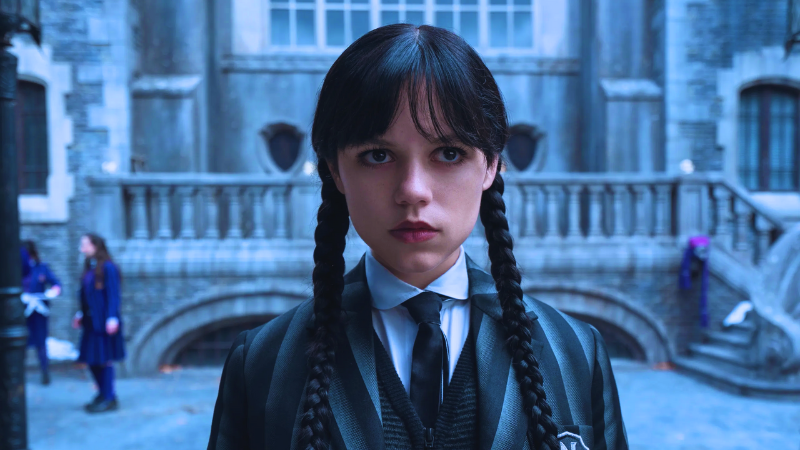
Few stars wear fashion with such consistent thematic clarity. Jenna loves that Wednesday’s wardrobe is “textile storytelling.” She sees her costume as a second skin. This season, she notes, black suits are replaced or accented with deep plum and forest hues, symbolizing Wednesday’s emergent emotions. Jacqueline Durran, the costume designer, collaborated with Jenna to embed hidden details—a locket sewn into Wednesday’s lapel with Morticia’s name, fingerless gloves stitched with week-night symbols of school life. These details, Jenna explained, help breathe life into the character, turning fabric into narrative shorthand.
She embraced co‑designing details, even offering suggestions like a pin shaped like a centipede: a nod to unseen emotions creeping beneath her calm. She said writing the show into her jacket felt empowering—the same reason she grasped script pages with fingerprint grease. Wednesday is wearing her story externally as well as internally.
Learning from the Addams Legacy
Naming Wednesday Addams is to inherit one of television’s most iconic roles. Jenna did not take that lightly. She watched every episode from the original series and critically examined Christina Ricci’s portrayal, remarking how Ricci made Wednesday’s stillness operatic. Jenna credits that as an early template, but she wanted her version to feel generationally unique. Her Wednesday is digitally fluent; she flips through spell books on her tablet. She makes TikToks out of funeral home aesthetics as protest. The goal wasn’t to replicate, but to evolve.
She spoke with Christina Ricci before filming began, and said the veteran actress’s blessing and insight allowed her to step into the silhouette while reimagining the shape. Ricci reportedly said, “Stay miserable. Stay smart—but don’t forget Wednesday can see things we humans can’t see.” That conversation, Jenna told me, shaped her approach to Season 2—balancing darkness with vision, vulnerability with clarity.
Filming During a Pandemic-Era World
Season 2 faced production challenges. Filming began amid shifting health protocols, and Jenna described the tension of negotiating mood through masks, testing, and airflow monitors. She said that in early pandemic shoots, the silence between scenes felt heavier, and masks muffled whispered rehearsal notes. Striking emotional tones on camera required extra eye contact and vocal precision. The situation ironically sharpened her craft—Her Wednesday’s gaze carries more weight now, more focus on small twitches, slight shifts around the eye.
That heightened attention to micro-expression allowed her to mine deeper emotional content in Season 2’s most intimate scenes—like her conversation with her mother about mortality, set in a crumbling greenhouse dripping with ivy. Jenna showed me footage of her staring at a droplet fall off a vine and letting it frost into silent tears. Masks and distance taught her restraint—and yielded a richer palette of expression.
Collaborating with Cast and Crew
Jenna spoke at length about her on-set synergy with co-stars. Catherine Zeta‑Jones plays Morticia with statuesque compassion; she and Ortega locked in a dance of long looks and slow smiles in one powerful greenhouse scene. Jenna said she and Zeta‑Jones connected while discussing motherhood, loss, and strength during a late-night rehearsal in a library full of arcane tomes and dust. That emotional bond, she believes, is part of what Season 2 drama centers on.
Her chemistry with Emma Myers as Enid is less formal but no less real. Jenna described Emma as the script-less truth teller: “She’d spill pizza if that’s how Wednesday got grounded again,” Jenna laughed, “and Wednesday would smile slightly. That tiny smile means everything.” The performances are entwined—Wednesday’s ascetic rigidity is pronounced only when contrasted with Enid’s warmth and movement.
She also praised the crew’s emotional stamina. The sound team built spatial audio to mimic dripping water in nightmare sequences. The lighting crew played with steely blues in contrast to deep amber glow during emotionally revealing moments. These theatrical layers, Jenna admitted, shaped her performance.
Social Activism and Stardom Responsibility
Off camera, Ortega’s voice is fervent and articulate. She uses her platform to advocate for climate action, immigration rights, and Latino representation. In Season 2’s finale, Wednesday delivers a pointed speech about community responsibility—a line Jenna wrote based on notes from community activists she’s met. She believes the show’s voice should be more than ironic veneers; it should pierce through and invite reflection.
She told me she hopes Gen Z watchers feel seen, not condescended to. She wants them to see itself in Wednesday’s moral toughness, skepticism, and capacity for care. The viral fashion trend of Wednesday’s black lace dress is great, but she cares more that fans are talking about kindness, grief, and awareness behind that dress.
What Season 2 Promises—and What Comes After
Jenna hinted at a Season 2 finale that sets Wednesday on a new pilgrimage—beyond Nevermore. She sees Wednesday grappling with newfound responsibilities that may drive her away from the academy she’s always resisted. Jenna hopes future seasons explore more of her grief and growing leadership, and perhaps invite crossover with other iconic noir or supernatural series.
After Wednesday, Ortega expressed a desire to return to her film roots—perhaps a horror anthology series or a biopic of a trailblazing Latina. She doesn’t yet know her next move, but is clear she wants to avoid inertia. “I feel tethered to change,” she said softly. “Wednesday has been my north star, but I’m looking at other constellations now.”
Final Reflections on a Young Voice in Hollywood
Two seasons in, Jenna Ortega has moved beyond viral starlet status. Her Wednesday is imperfect, incendiary, deeply human—a performance that resonates with communal longing for honesty and introspection amid chaos. Off-camera, she stands as a credible voice—an actor who wears goth but thinks, who advocates loud, and who builds legacy quietly.
When she signed off, Jenna asked me about my own lockdown library and what spooky stories I’d add to ours. That gentle shift—from celebrity interview to shared human curiosity—captured the essence of who she is. The Wednesday fans know on screen may be dark, but the young woman behind the character is luminously earnest: proud, playful, and ready to grow.