
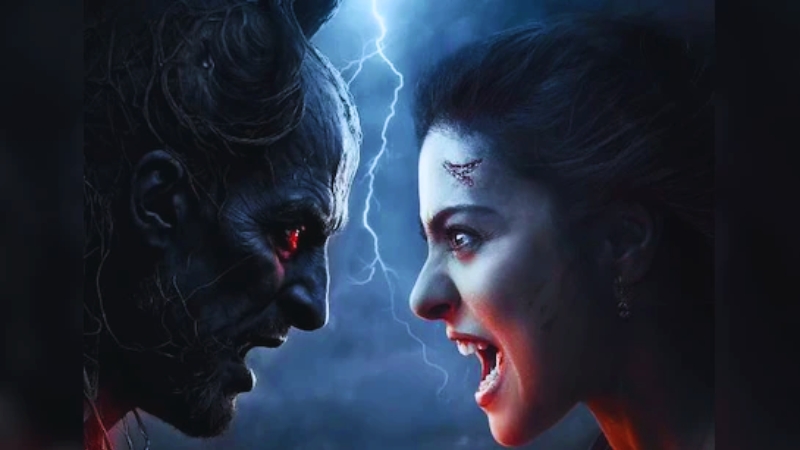
In Maa, Bollywood icon Kajol steps into the role of an action-horror heroine — a fierce mother standing between her child and supernatural evil. Armed with mythological symbolism, eerie settings, and a premise rooted in religious folklore, Maa aims to be an ambitious addition to India’s growing horror genre and the expanding universe started by Shaitaan (2024). Unfortunately, despite its thematic potential and a compelling central performance, the film struggles under the weight of a confused script, weak antagonist, and underwhelming horror elements.
The idea of a mythological horror film anchored by a maternal figure is inherently intriguing. Combine that with the presence of Kajol — an actress whose career spans romantic dramas, intense thrillers, and family sagas — and expectations run high. But while Maa taps into powerful emotional and cultural tropes, it rarely rises above genre clichés or narrative incoherence.
Kajol, the Divine Feminine, and a Mother’s Wrath
Kajol plays Ambika, a woman whose past is cloaked in mystery but whose present revolves around protecting her 12-year-old daughter, Shweta (Kherin Sharma). When they visit the remote village of Chandanpur near Kolkata, Ambika is pulled back into a world of ancient rituals, demonic threats, and sacred battles — quite literally. A supernatural entity known as Doito (a corrupted Bengali form of “asura” or demon) is after Shweta, believing her to be key to unleashing chaos once again.
The story leans heavily on Hindu mythology, particularly the legend of goddess Kali and the demon Raktbeej, whose spilled blood could generate endless replicas of himself. In traditional lore, Kali defeats him through pure rage and destruction, consuming him completely. Here, Ambika serves as a symbolic stand-in for Kali — even her name is one of the goddess’s epithets — and the film hints at her divine essence.
Kajol, as expected, brings a measure of gravitas to the role. Whether she’s holding a torch in a dark corridor or squaring off against evil forces, her presence commands attention. It’s a performance grounded in emotional realism — she plays Ambika not as a superhero, but as a woman driven by primal maternal instinct, fear, and suppressed strength. It’s the most convincing aspect of the movie, and perhaps the only one that holds steady throughout its runtime.
From Myth to Modern Horror: A Good Idea on Paper
Directed by Vishal Furia (Chhorii, Bali) and written by Saiwyn Quadras (Neerja, Mary Kom), Maa attempts to blend horror with mythological storytelling. This subgenre is not entirely new to Indian cinema, but it remains underexplored. Films like Tumbbad (2018) proved that combining folklore with atmospheric horror can yield cinematic gold. Maa tries to tread similar territory but lacks the narrative focus and visual conviction required to pull it off.
The film’s core conceit — the collision between ancient evil and maternal love — is rich with metaphor. It resonates particularly in Indian cultural contexts, where the archetype of the protective mother (often likened to Durga or Kali) carries enormous symbolic weight. However, where Tumbbad or even Bulbbul used mythology to enhance character and atmosphere, Maa leans too heavily on exposition and underdeveloped visual metaphors.
There are multiple layers the film tries to unpack: motherhood as divine power, the legacy of female strength, generational trauma, and the spiritual battle between good and evil. Unfortunately, these themes are presented more as bullet points than actual ideas woven into the story. What should have been mythological horror ends up feeling like mythological homework.
The Return of the Shared Universe: Ties to Shaitaan
Maa is the second installment in what appears to be an emerging supernatural shared universe kicked off by Shaitaan, which starred Ajay Devgn and R. Madhavan in a tight, psychological thriller about demonic possession and parental desperation. The final moments of Shaitaan teased the spiritual underpinnings that now take center stage in Maa, with Devgn’s character remarking, “In the entire universe, there is no stronger god than a mother.”
It’s an apt line — and clearly a thematic springboard for Maa — but where Shaitaan succeeded through its contained, emotionally charged narrative, Maa sprawls in too many directions. The connection to the earlier film is more thematic than narrative, and the inclusion of shared elements (like similar visual motifs and a shadowy mythology) doesn’t quite cohere into a satisfying whole. It feels more like a brand extension than a genuinely interconnected story universe.
The Demon Doito: Groot’s Evil Cousin?
Every horror film lives or dies by its antagonist, and Maa’s greatest failure lies in its creature design and lackluster villain. Doito, the demon that threatens Shweta, is a towering, bark-covered monster with branches for limbs and vague malevolence in his voice. Instead of inspiring dread, he inspires comparisons to Marvel’s Groot — if Groot had a bad day and wandered into the wrong movie set.
Despite some serviceable VFX and an eerie sound design, the character of Doito lacks personality. He doesn’t represent a true existential threat — nor does he provide any deeper metaphor or psychological underpinning. His dialogue is generic, and his appearances feel routine rather than terrifying. There’s nothing demonic about him beyond appearance, and his motivations remain murky throughout. For a film rooted in one of Hinduism’s most fearsome myths, this representation of evil is disappointingly shallow.
Compare this to R. Madhavan’s turn in Shaitaan, where the antagonist’s delight in chaos made him both magnetic and terrifying. That film worked because the villain was grounded in character — his evil wasn’t just abstract; it had intention. Doito, by contrast, is all bark and no bite.
A Haunted Village With Little Atmosphere
The setting of Maa — Chandanpur, a fictional village near Kolkata — offers visual potential. Bengali culture has long served as fertile ground for horror and gothic tales, from literary ghost stories by Rabindranath Tagore to films like Anvitaa Dutt’s Bulbbul and Satyajit Ray’s Monihara. The film tries to echo that lineage, with a sprawling rajbari (palatial estate), misty temples, and Kali Puja rituals. But it all feels strangely flat.
The production design is occasionally striking, but the cinematography and pacing fail to build a sustained atmosphere. The forest sequences — meant to feel foreboding — look overly artificial. The mansion is large but underutilized, with minimal spatial tension or architectural eeriness. The horror sequences, when they arrive, are formulaic: doors creaking, shadows moving, jump scares that land with a thud.
What Maa needed was a deeper investment in mood and psychological dread. Instead, it gives us a checklist of horror tropes without the execution. Even the film’s structure — divided into acts with rising stakes — feels off-tempo. The climactic sequence tries to recreate the chaos and mysticism of Shaitaan‘s finale, but the visuals and staging pale in comparison.
Feminist Undercurrents and Missed Opportunities
There are feminist themes embedded in Maa — both explicitly and subtly. The story of a mother taking up arms to protect her daughter has inherent resonance. There are also moments when the film seems to critique the societal tendency to silence or sacrifice women in the name of tradition. In one subplot, rituals involving human sacrifice serve as both horror fodder and commentary on how women’s lives are commodified.
However, these threads are never developed beyond surface gestures. Compared to more effective feminist horror in Indian cinema — Stree, Bulbbul, or even the recent Gaslight — Maa struggles to integrate its messages into the narrative. It wants to say something about motherhood as divine power, about female rage, about inherited trauma, but it doesn’t stay focused long enough to deliver those points with conviction.
A Myth Missed in Execution
Maa is a film with powerful building blocks — a mythological foundation, a strong female lead, and a culturally rich backdrop — but it fails to assemble them into a cohesive whole. The horror is toothless, the plot unnecessarily convoluted, and the pacing sluggish. For every moment of emotional sincerity from Kajol, there’s a scene that meanders or loses tension.
That said, the film is not without merit. Kajol’s performance is strong, and the effort to blend Indian mythology with horror is commendable, even if the result is uneven. One hopes this experiment leads to bolder, more effective entries in the emerging myth-horror subgenre. Filmmakers in India are clearly eager to push genre boundaries — they just need scripts that match their ambition.
A Divine Warrior, Let Down by Mortal Flaws
Kajol’s Ambika deserves a better film. Her portrayal of a mother grappling with ancient evil and modern trauma could have been the anchor of a memorable genre piece. Instead, Maa delivers a confused, often flat experience that gestures toward greatness but rarely touches it.
If the makers of this budding horror universe want to continue exploring myth, mysticism, and motherhood, they’ll need to tighten their storytelling, sharpen their scares, and give their goddesses the demons they deserve.